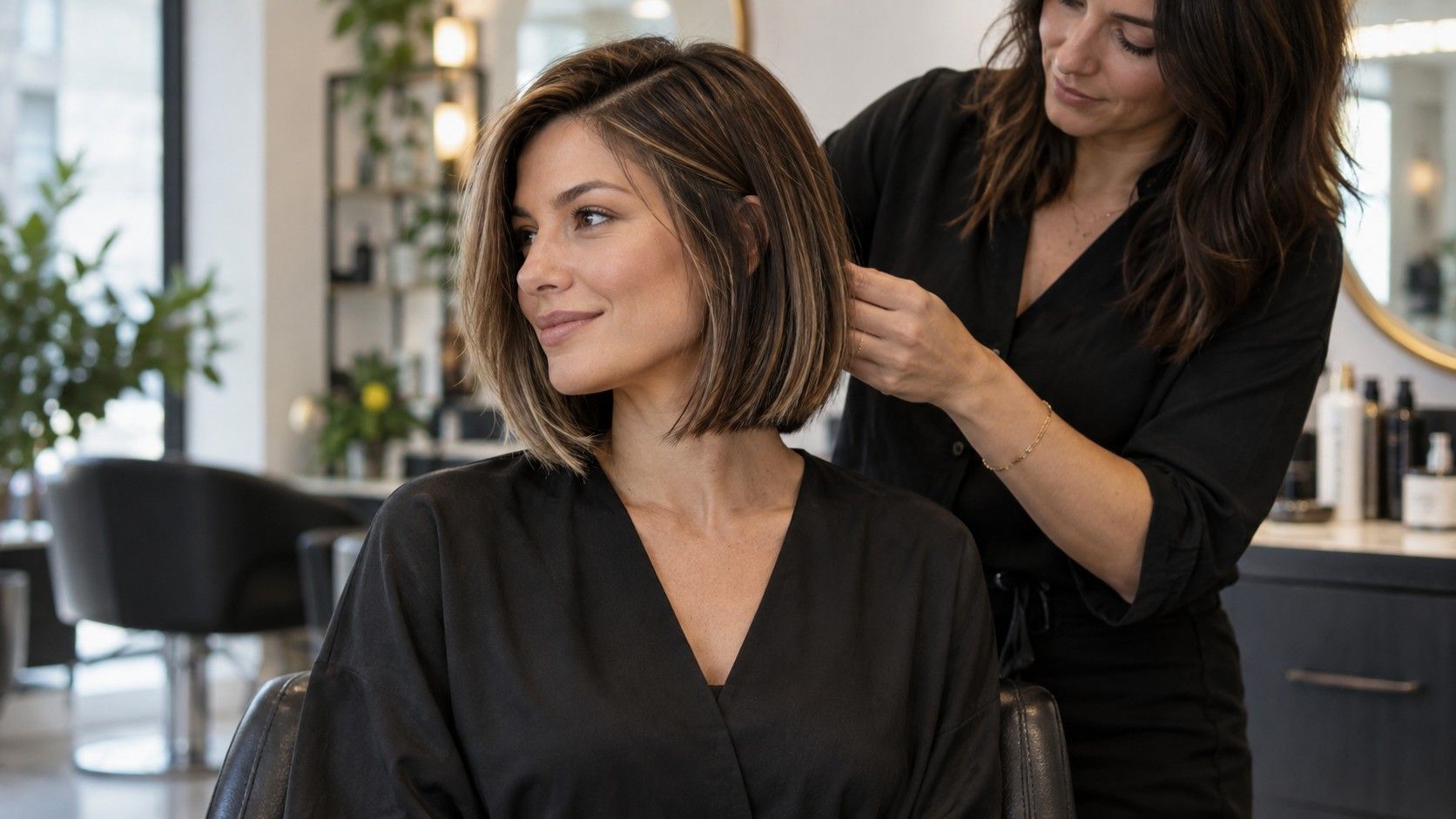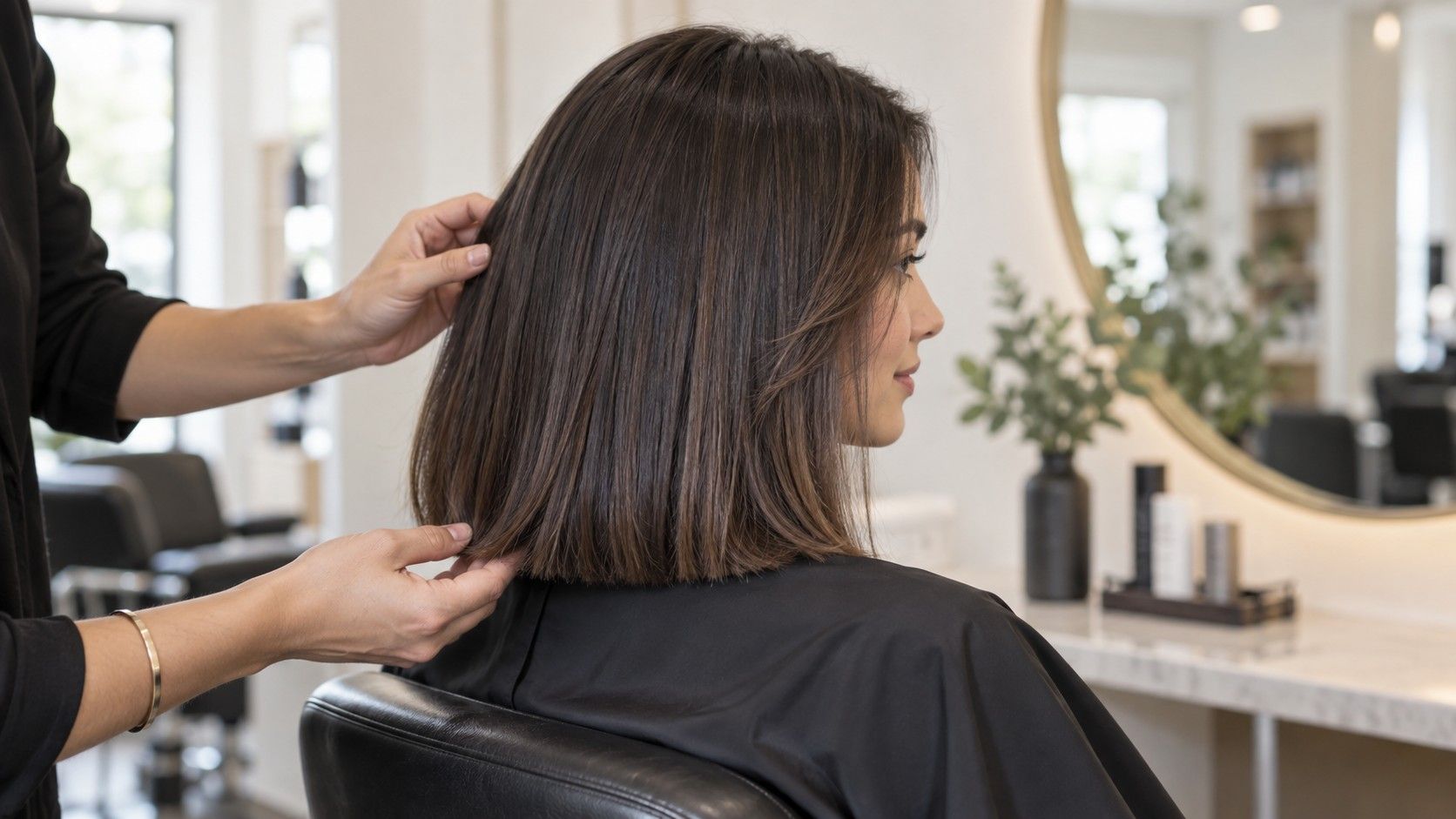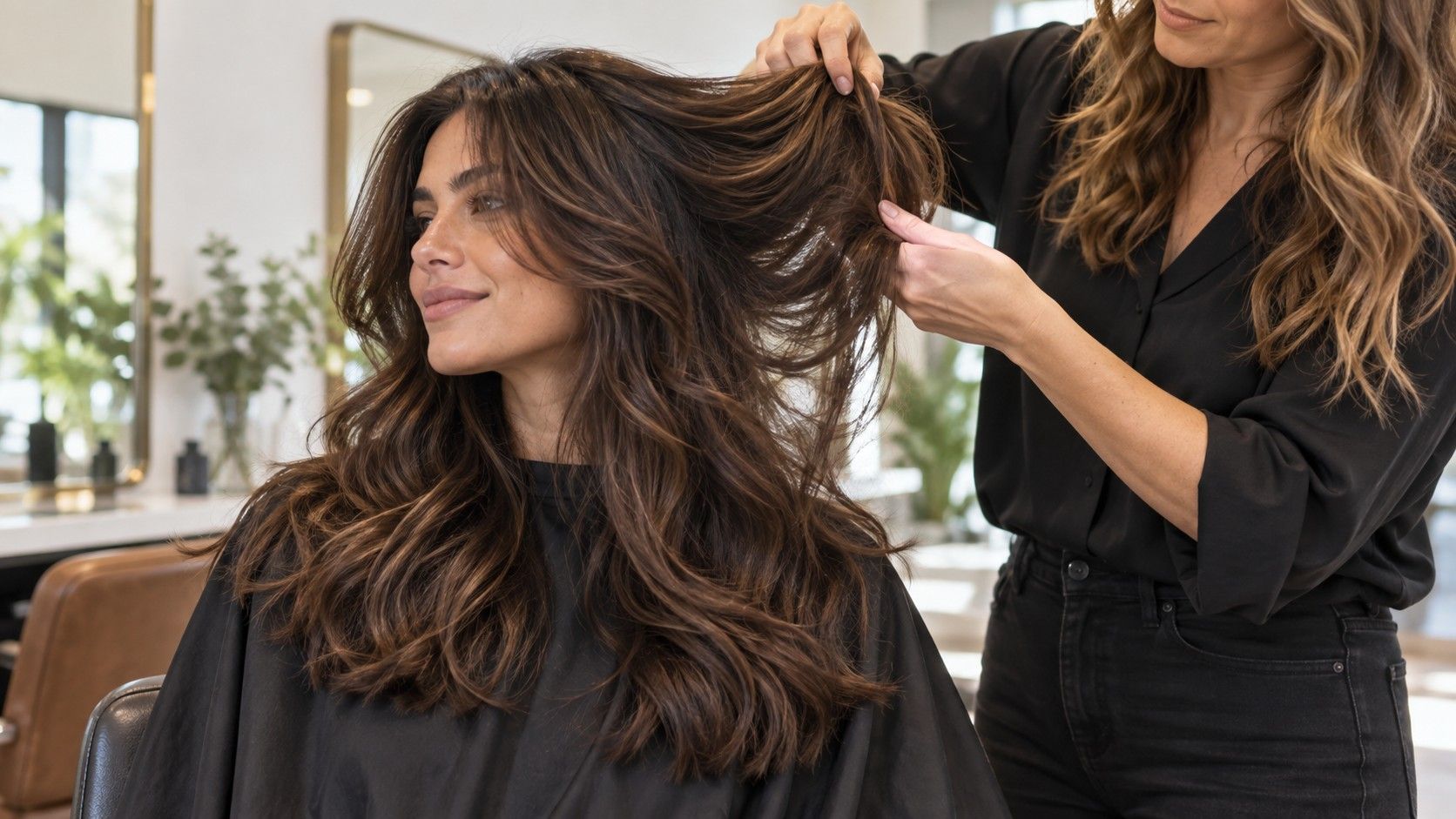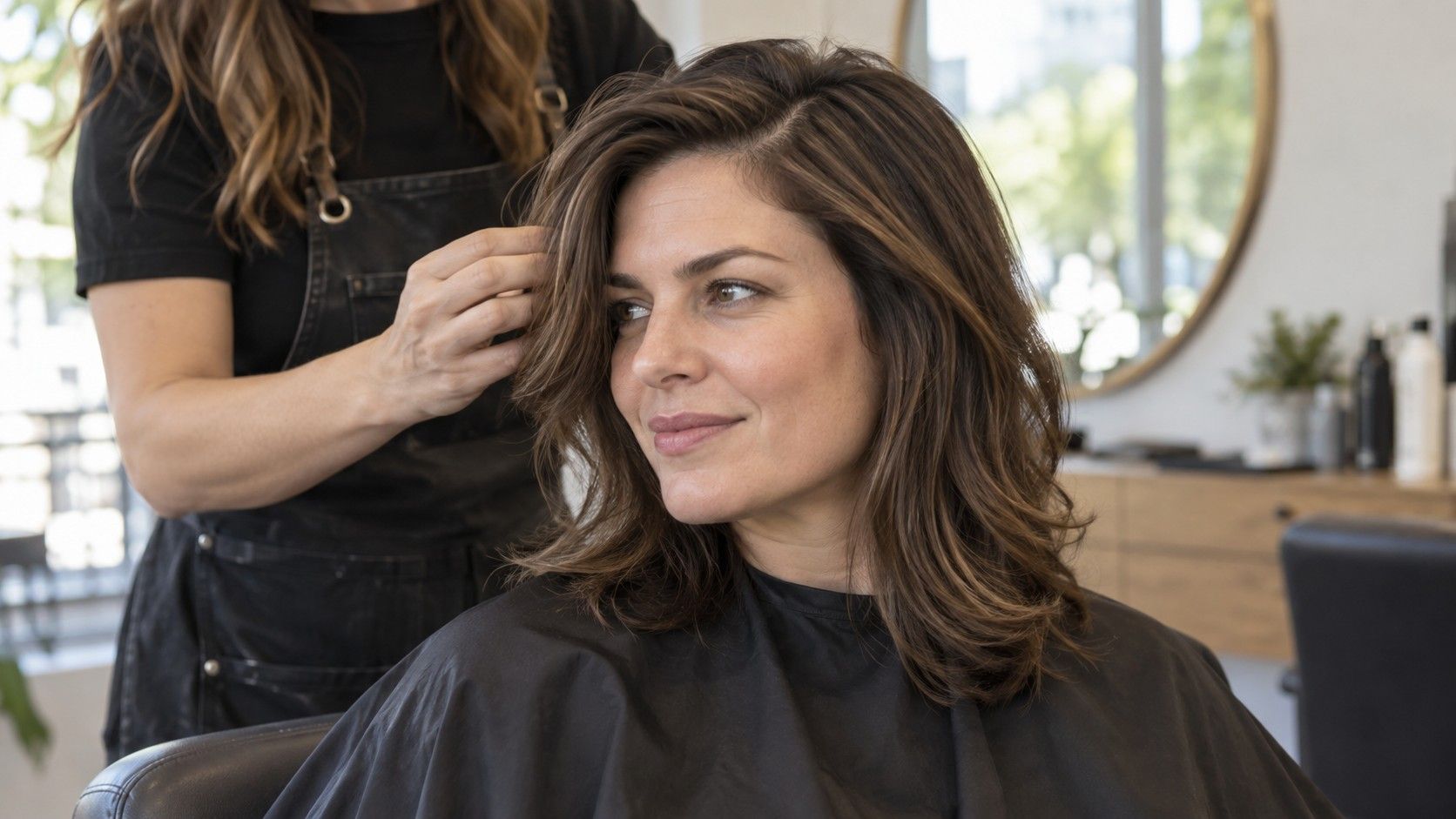
A part is one of those details that looks trivial until it is wrong for the rest of the cut. With a square face, a line drawn through the crown can either let the eyes and cheekbones do the talking or make the forehead, temples and jaw seem arranged in the same hard geometry. The useful question is not whether a centre or side part is universally flattering. It is which placement leaves a little movement around your face on an ordinary Tuesday, after the blow-dry has gone and the weather has had its say.
Why moving the part changes more than the top of your head
A square face usually has a forehead, cheek area and jaw that read as fairly similar in width, with a jawline that feels defined rather than tapered. A hair part adds a vertical or diagonal line above that shape. Put a perfectly crisp centre part over hair that sits flat at the temples and the eye can travel straight down to both jaw corners. Shift the line slightly and the two sides no longer mirror one another; that interruption is often enough to make the overall frame feel less boxy.
The temple area matters more than most diagrams admit. When hair is tucked tightly behind both ears, even a good part can expose the widest horizontal impression of the face. Leave a soft bend, a feathered layer or a bit of root lift at one temple and the part has something to work with. Think of it as changing the outline, not disguising it. A defined jaw can be striking; the aim is simply to avoid adding another ruler-straight edge above it.
Texture decides how strong the effect will be. Fine, straight hair often shows a part very clearly, so a few millimetres make a visible difference. Dense curls may naturally resist a precise division, and forcing one with a comb can create an odd, separated canopy. In that case, find the point where the curl pattern already opens near the crown, then guide it rather than fighting it. The best hair part for a square face is usually the one that belongs to the hair you actually have.
A centre part can work when it is not too severe
A centre part is not forbidden territory for a square face. It tends to look especially good when the length falls below the chin, the hair has enough body beside the cheeks, and the ends are not cut into one blunt shelf. Long curtain fringe, face-framing layers beginning around the cheekbone, or loose waves all soften the symmetry. The centre line stays clean while the perimeter does the gentler work.
The version that often disappoints is a pin-straight centre part combined with very flat roots and a one-length bob ending exactly at the jaw. That combination asks every line to be precise: scalp line, cheek line, cut line, jawline. It can look editorial in a carefully lit photo, but it is unforgiving in a car mirror or under overhead office lights. If you like the centre part, ask for a slightly broken finish at the ends rather than assuming you need to abandon it.
A small styling adjustment makes a larger difference than another inch of length. Dry the roots in opposite directions first, then let them settle into the centre so they retain a little lift. Do not rake both sides tightly back from the forehead with a fine-tooth comb. A natural, almost imperfect centre part has more softness than a dark line pressed sharply into the scalp. It also survives a windy walk better, which is not a minor consideration if you do not plan to restyle at noon.
| Part placement | What it can do for a square face | Watch for |
|---|---|---|
| Centre part | Keeps a balanced, modern frame when paired with volume or a soft face frame | Flat roots and a blunt jaw-length cut can make the look too rigid |
| Off-centre part | Adds quiet asymmetry without looking deliberately side-swept | Moving it too far can expose one temple more than intended |
| Deep side part | Creates height and a diagonal sweep; useful with waves or a fringe | May fall flat on the heavier side unless the roots are supported |
The off-centre part is the reliable middle ground
For many people, an off-centre part is the easiest place to start. Move your existing centre line about a finger-width to either side, rather than creating a dramatic diagonal. You get asymmetry, but nobody has to learn a new styling routine. This is particularly helpful if your hair is medium length and naturally falls around the jaw or collarbone, where a minor shift can change which strand lands across each cheek.
Choose the side by looking at your real growth pattern, not by copying a celebrity photo. Most scalps have a cowlick or a denser direction at the front. Parting with that movement will give you a little lift; parting against it may look good for twenty minutes and then split open at the crown. Stand near a window, tip your head forward once, and see where your hair wants to separate when you lift it back. That is usually a more reliable starting point than a face-shape rule.
The off-centre line also gives short cuts more room to breathe. On a pixie or a cropped bob, keep some softness over the stronger temple and avoid slicking both sides equally close. With longer hair, it creates a place for one side to be tucked and the other left loose. That unequal treatment sounds small, but it stops the face from being framed by two matching vertical curtains.
When a deeper side part earns its place
A deeper side part can be useful when you want obvious volume at the crown or when a fringe already sweeps to one side. It creates a diagonal that pulls attention across the face rather than straight down it. The effect is strongest with a side-swept fringe, a soft wave through the front lengths, or a shoulder-length cut that has some internal layers. On hair that is completely straight and very long, it can still work, but it needs root support or the heavy side may collapse against the cheek.
There is a practical limit. If the part begins too far toward one ear, the exposed side can reveal the hairline and temple in a way that feels less balanced, especially with glasses. Try the position while wearing the frames you use every day, not just with your hair clipped away in a bathroom. The arms of glasses, an ear tuck and a deep part can all compete for the same small area of the face.
For a night out, a deeper side part can look polished with one bend of a curling iron placed at cheek level. For daily wear, a looser version is kinder. Blow-dry the roots across the crown, let them cool, then settle the part with your fingers. Spraying the scalp into submission may hold the line, but it often makes the hair look separated and gives the part more visual weight than you intended.
Match the part to layers, fringe and the length around your jaw
A hair part for a square face cannot be judged in isolation from the cut. The most forgiving combinations tend to have some give around the face: a long fringe that opens, layers that begin below the cheekbone, or a bend that lands between the cheek and jaw. These features soften the transition from forehead to jaw without pretending the jaw is a problem to solve. A skilled stylist will look at where your hair naturally drops before deciding where the shortest face frame should sit.
Be cautious with a heavy straight fringe that ends across the forehead and a sharply centred part behind it. That can create a broad horizontal block above an already broad-looking upper face. A wispy fringe, split fringe or fringe brushed a little to one side is often easier to live with. It lets the forehead appear in pieces rather than as one solid band, and it grows out more gracefully when you miss a trim appointment.
Bob length is another detail worth testing honestly. A bob that stops right at the jaw can look intentional, but if it is also blunt and flat, it may underline the widest, strongest line in the face. Move the part off centre, add a soft wave, or choose a length just below the jaw instead. None of those changes needs to be dramatic. The point is to make sure the cut and part are not all voting for the same hard edge.
Do a five-minute mirror test before changing your routine
You do not need an appointment to test a new parting. Start with clean-ish dry hair, your usual makeup or glasses, and daylight if possible. Make a centre part, an off-centre part and a deeper side part. Take one front-facing photo of each without lifting your chin, then one at the slight angle you naturally use in conversation. Phone cameras flatten depth, but they are useful for showing whether the part has created a dark, severe stripe or whether it gives the front of the hair more air.
Then move around for a few minutes. Lean over to pick something up, tuck one side behind your ear, and shake your head gently. The winning part is not necessarily the most flattering still image. It is the one that returns to a believable place afterwards. If it opens at the crown, falls into your eyes, or leaves one side looking stringy, it will demand more morning effort than the result is worth.
If you are seeing a stylist, bring two or three photos of your own tests rather than only inspiration shots. Point out whether you like more height, a softer temple, or hair kept away from one cheek. Those observations are more useful than saying you want a magic hair parting for a square face. A good part is a small adjustment, but paired with the right face frame and your natural texture, it can make the whole haircut feel more considered without making you look unlike yourself.