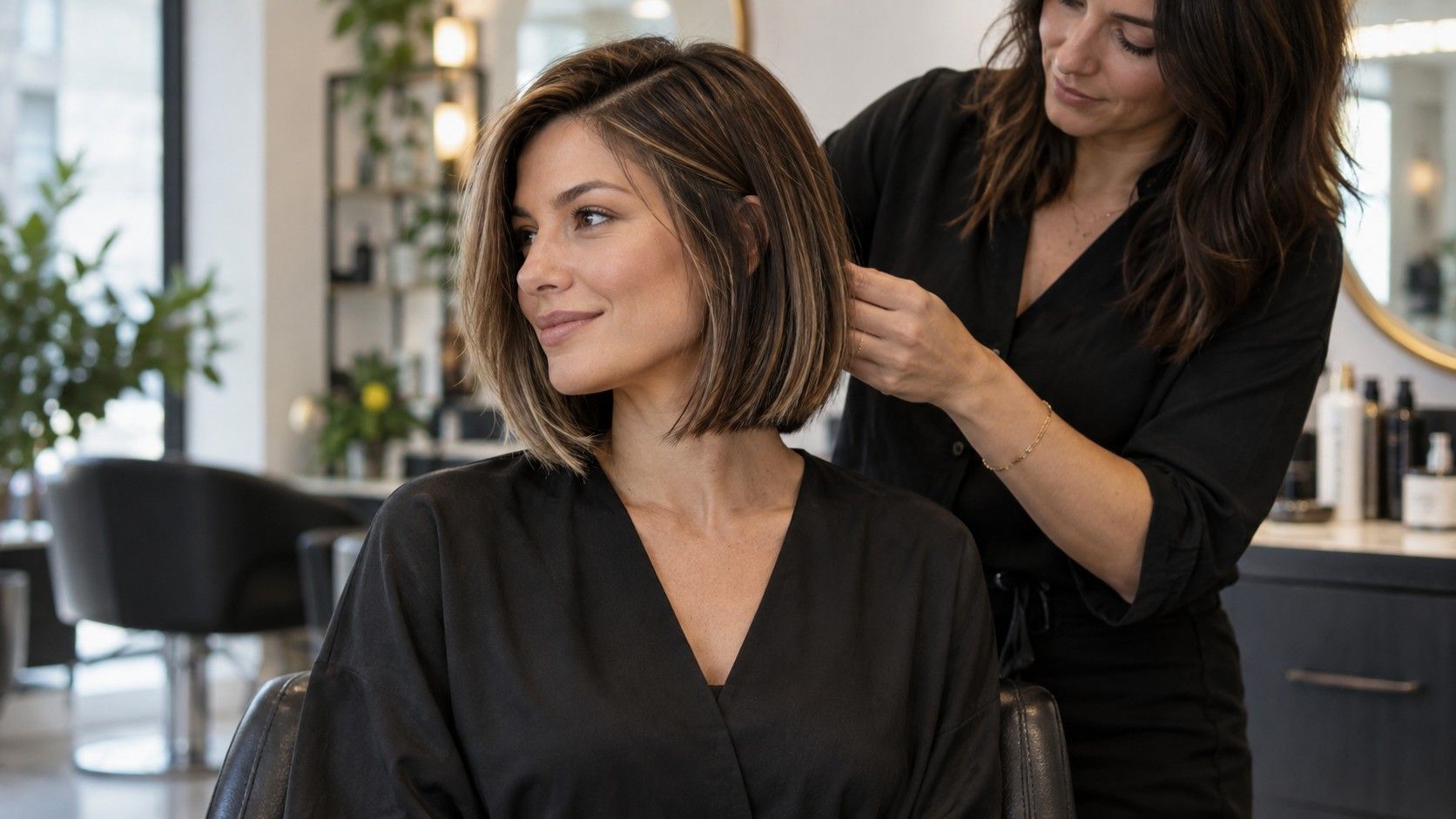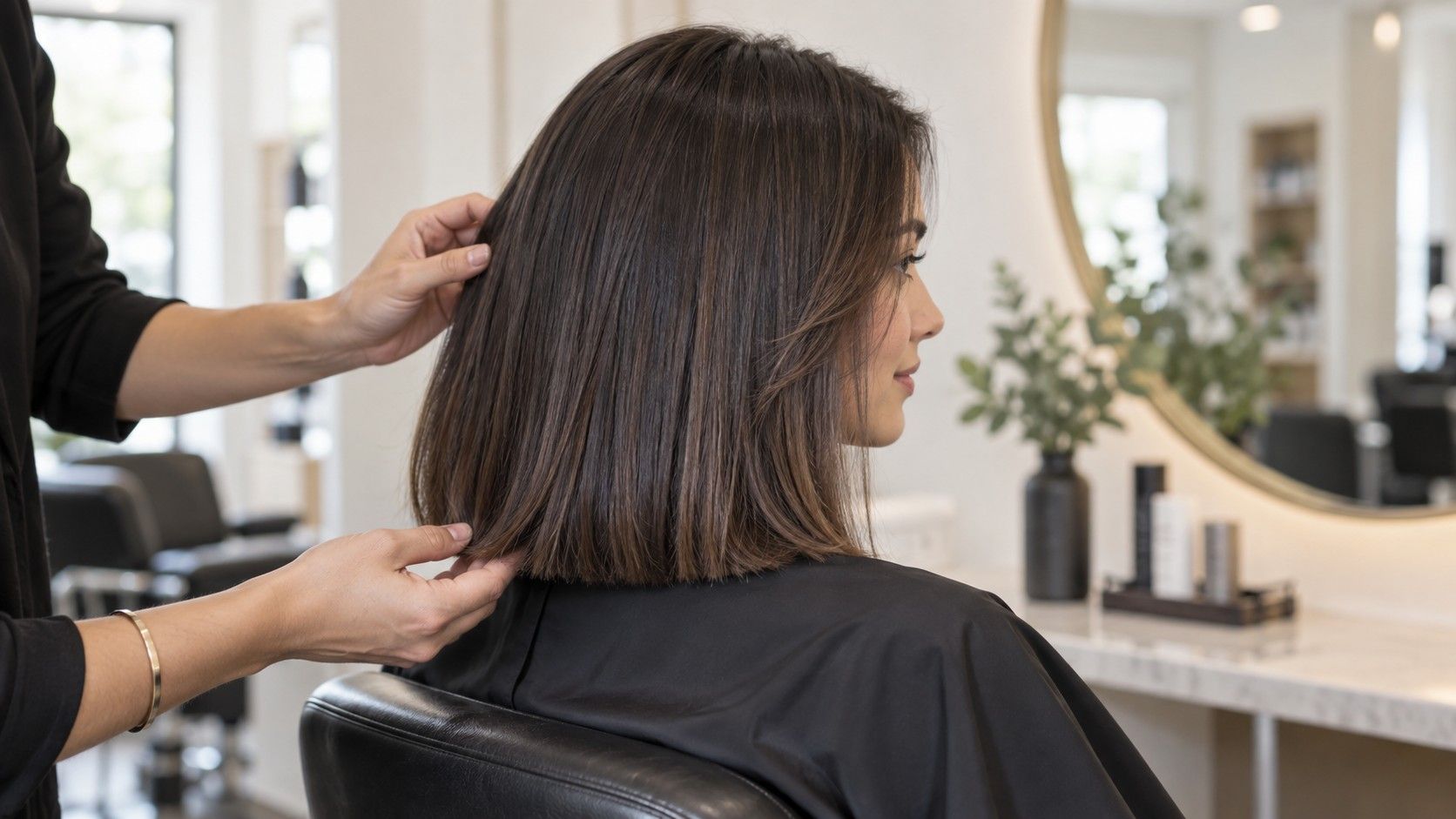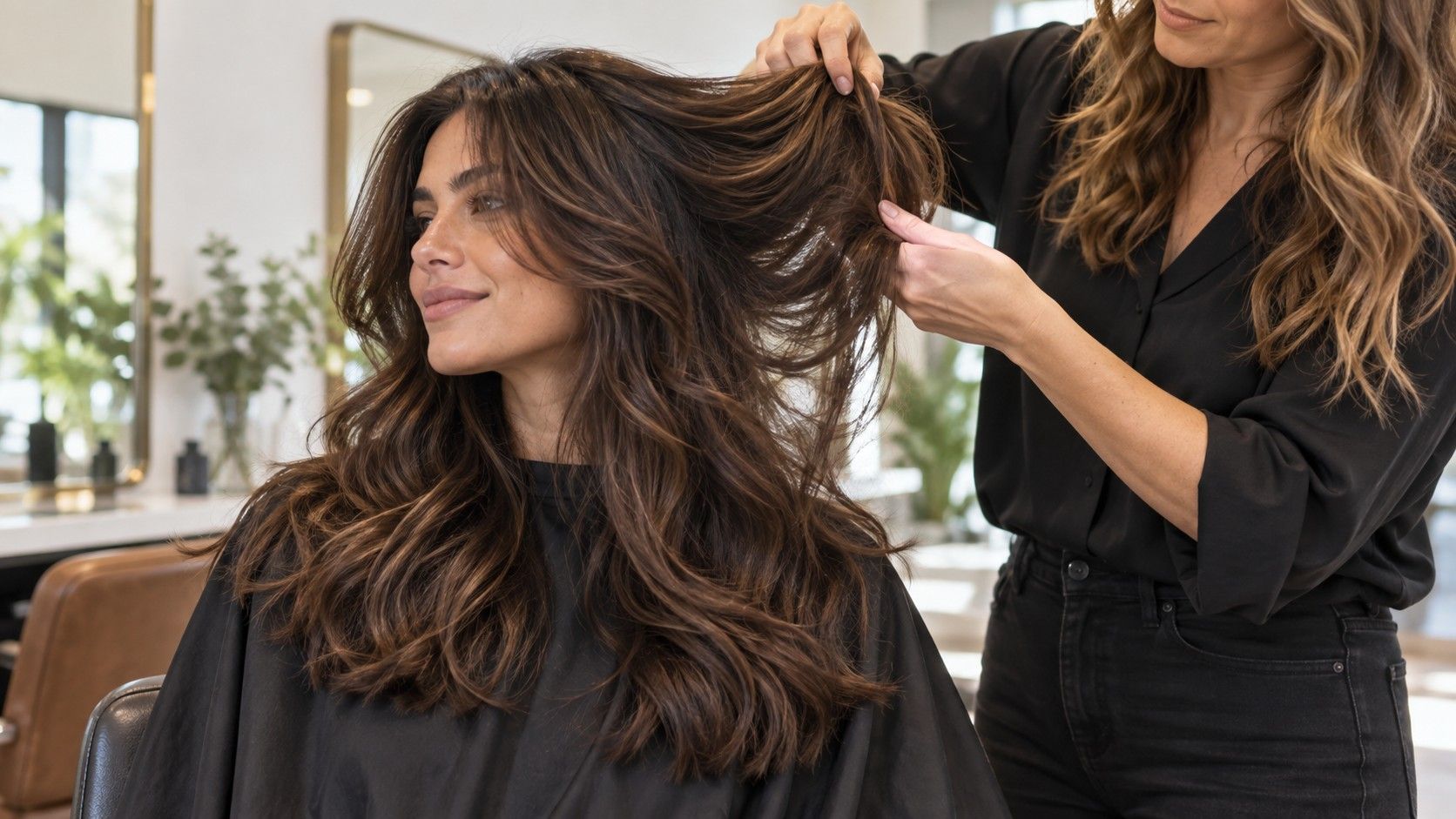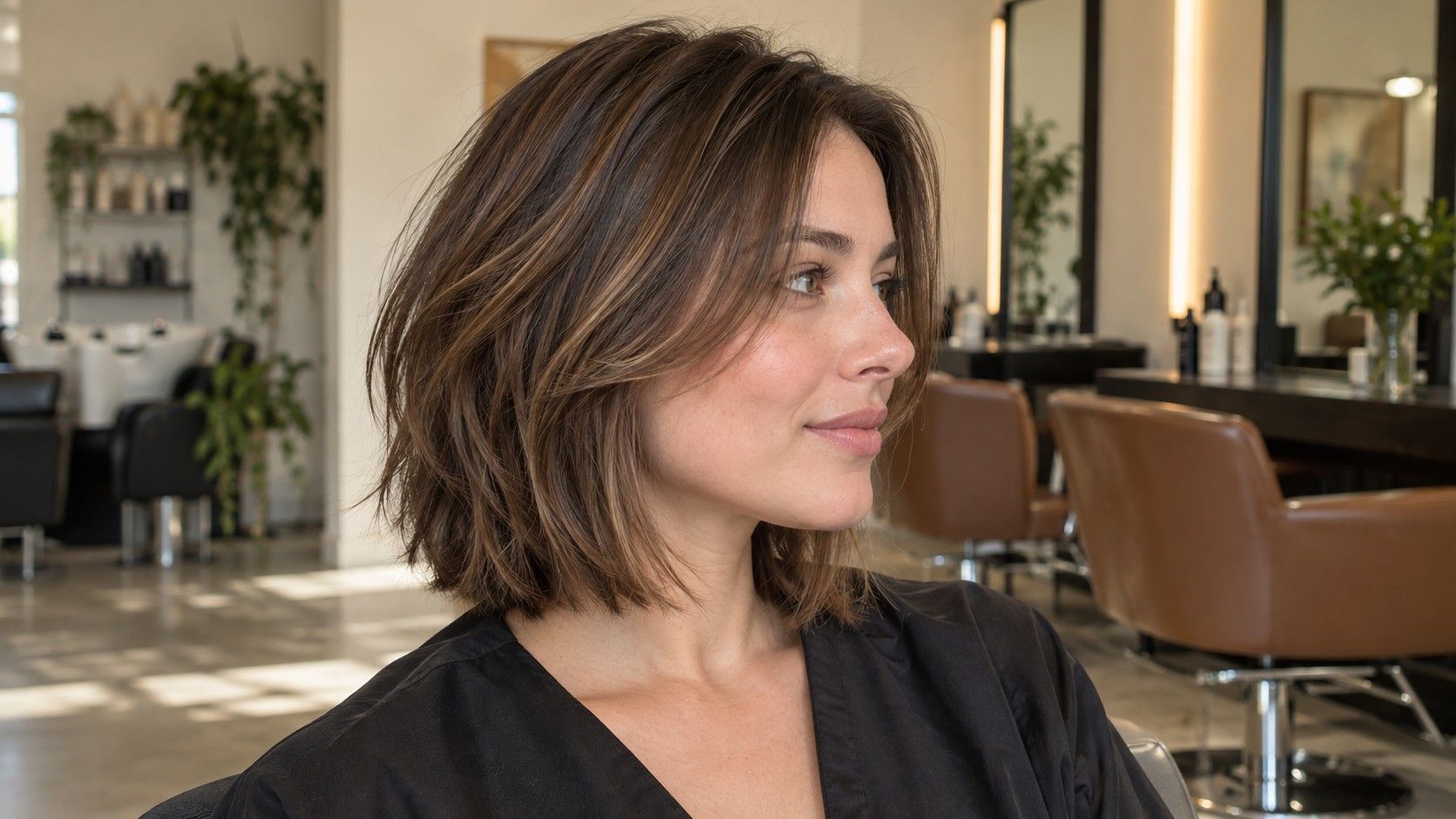
Choosing a haircut by face shape can be useful, but only if it stays a conversation rather than a set of rules. A chart cannot see the way your hair expands in damp weather, the glasses you wear every day, or the fact that you put it in a low ponytail before work. Length changes the silhouette around the face, yet the result also depends on texture, density, neck length and where the hair naturally parts. The most convincing choice usually comes from looking at all of those things together.
Why length changes the silhouette more than most haircut names
A haircut name tells you very little about where the eye will land. Two bobs can have entirely different effects: one ends sharply at the jaw, while another falls below it with soft movement at the front. The first makes the jawline a feature; the second can create a longer, quieter vertical line. A pixie exposes the forehead, temples and neck. Hair at the collarbone places visual weight lower down. Very long hair can draw the eye toward the chest unless its shape opens around the face.
This is why face shape and hair length work better as a proportion problem than a category problem. Look in a mirror from a few steps back, with your hair pulled away from your face. Notice the widest point of your cheekbones, the width of the forehead, and whether the lower third feels narrow, square or rounded. Then put your hair down and ask where its bulk sits. A cut can soften, repeat or deliberately contrast those lines; none of those outcomes is automatically right or wrong.
Measure proportions before deciding you are oval, round or square
Many people have a mix of shapes rather than a clean diagram. A face can be slightly longer than it is wide, with a broad forehead and a firm jaw. Another can look round when the hair is pushed back but become more oval once a side part and soft fringe are added. Labels are a useful shorthand for a consultation, not a diagnosis that should force you into one length for years.
Start with four observations: forehead width, cheekbone width, jawline shape and overall length from hairline to chin. Then add the parts a face-shape graphic leaves out. A high hairline changes how a fringe reads. A short neck can feel crowded by a heavy bob that finishes exactly at the jaw. A long neck may make a cropped cut look elegant but can also make a very short nape feel exposed if that is not your preference. These details are often more relevant than whether you measure one centimetre closer to oval or oblong.
Do not judge it only from the front. Side profile matters when choosing hair length for face shape, especially with a blunt perimeter. A chin-length line can project forward around the jaw, while a slightly longer front can lead the eye down the neck. Ask a stylist to show the proposed shape from both sides before the final cut. This small pause is more useful than asking whether a celebrity with a similar face shape once wore the style.
| What you notice | Length choice to explore | Question to ask before cutting |
|---|---|---|
| Face appears shorter or wider in photos | Below-chin or collarbone lengths with a little vertical movement | Will the widest part of the cut sit at my cheeks? |
| Face appears long and narrow | Chin to shoulder lengths, waves or a soft fringe | Does the crown height make the face feel longer? |
| Jawline is strong or angular | Lengths just below the jaw, textured ends or side movement | Do I want to emphasise the jaw or soften the line around it? |
| Forehead feels prominent | A side part, curtain fringe or longer front pieces | Can I style the fringe on an ordinary morning? |
| Neck feels short or crowded | A shape that clears the nape or falls past the collarbone | Where will the ends catch on collars and scarves? |
Short hair: choose the amount of exposure you really want
Short hair is often recommended for an oval face and discouraged for a round one, but that is too blunt to help at the salon. A short cut brings attention upward to the eyes, brows, temples and hairline. It can look crisp on a rounder face when the sides stay close and there is a little height or softness at the crown. It can also look severe on an oval face if the fringe is cut too bluntly and the top is left flat. The shape of the crop matters more than the permission to have one.
A first move into short hair is usually easier with a long pixie or bixie than with a close crop. Leaving enough length at the front gives you options: sweep it across the forehead, tuck it back, or let it break up a high hairline. Fine hair can benefit from this compact structure because it creates density near the scalp. Very thick hair needs careful internal removal, otherwise the sides can widen just where a round or heart-shaped face does not need extra bulk.
The chin is a particularly important stopping point. Hair ending exactly there makes the jawline conspicuous, which can be graphic and attractive if that is the effect you want. If the line feels too abrupt in the mirror, moving it two or three centimetres lower often changes the whole balance. Curly hair needs a different calculation again: a wet chin-length curl may dry above the jaw. Agree on the dry finished length, not the length visible while the cape is still on.
Medium lengths are where face shape and real life often meet
Hair from just below the chin to the collarbone is a flexible range because it can change direction without demanding a dramatic sacrifice. It gives enough length for a ponytail or clip, yet still holds a clear outline. For a fuller or rounder face, a collarbone cut with gentle face framing can create vertical movement without turning the hair into a curtain. For a longer face, shoulder-length waves or a side-swept fringe can add width in a controlled way rather than piling height on top.
The useful distinction is between a shape that has movement and one that has too many layers. On fine straight hair, aggressive layering can leave the ends thin and make the cut seem longer but less substantial. A fuller baseline with a few discreet pieces around the cheekbones often looks more expensive between appointments. On dense wavy hair, the opposite problem can occur: a single blunt line may grow into a triangle at the shoulders. Removing weight inside the cut, rather than chopping the surface into short layers, usually keeps the outside clean.
Pay attention to where the hair rests when you turn your head. A shoulder-length cut that flicks out on every coat collar can become irritating even if it flatters your face. A slightly longer collarbone length may be less dramatic in a consultation photo but far easier in daily life. This is also a good zone for someone growing out a pixie or recovering from breakage, because the shape can be adjusted every few months without starting over.
Long hair needs a plan for weight, not a default answer
Long hair is not automatically the safest choice for every face shape. It can be beautiful on round, square, heart and oval faces, but a flat, uninterrupted sheet of hair may make the face look narrower or pull the whole silhouette downward. The issue is usually not the number of inches. It is whether the length has enough shape near the face and enough density at the ends to look intentional.
For a face that feels rounder, long layers beginning below the cheekbones can avoid adding width at the fullest part of the face. Very short face-framing pieces can have the opposite effect when they puff outward at the cheeks. For a heart-shaped face, longer pieces near the jaw may balance a narrower chin, while a heavy fringe can make the forehead feel even wider. A square jaw can look striking with long blunt hair, though soft waves or a slightly rounded perimeter are often easier if you prefer less emphasis on the angles.
Texture decides how much structure long hair can carry. Fine hair frequently looks healthiest when the last few inches remain reasonably blunt; too many feathered layers make the perimeter transparent. Thick hair can handle more removal, but it still needs a clear bottom line or it may become a broad, shapeless mass. With curls, weight can be helpful because it prevents the sides from expanding too far, yet overlong curls may stretch out and lose their spring. A curl specialist should talk about shrinkage, not promise a universal length.
Texture, density and parting can override the chart
Face shape is only one part of hair face shape advice because hair itself occupies space. Fine hair tends to fall close to the head, so a very long cut can make the crown look flatter and the ends look sparse. A compact bob, a collarbone lob or a long cut with a stronger baseline may create a better silhouette than more layers. Thick hair can create width quickly, particularly at jaw and cheek level. It often benefits from hidden weight removal and a length that lets the texture settle before it reaches its widest point.
Straight hair shows every line clearly. That makes a blunt bob dramatic, but it also means a slightly uneven perimeter or an awkward grow-out is obvious. Waves are more forgiving at the ends and can add softness around an angular face, although they need enough length to form rather than kick outward. Curls bring their own scale: a rounded curl shape can add width at the cheeks, while longer layers can distribute that volume downward. Neither outcome is bad; it simply changes which length feels balanced to you.
Parting is the quiet partner in this decision. A middle part can suit a symmetrical face but expose a sparse hairline or make fine roots lie flat. A soft off-centre part can provide lift without the drama of a deep side sweep. If you switch parts often, tell your stylist. A cut that relies on one exact division may look polished at the appointment and strangely lopsided at home once your hair follows its usual growth pattern.
Take a better question into the salon chair
Instead of asking, ‘What hair length suits my face shape?’, try arriving with a few honest constraints. How often are you willing to trim it? Do you heat-style it, diffuse it, or mostly let it dry? Must it fit into a ponytail for work, exercise or childcare? Do you want your jawline to be noticed, or would you rather the haircut frame it softly? These answers give a stylist something concrete to design around.
Bring reference photos with similar hair texture and density, not only a similar face. One picture from the front and one from the side are more useful than a gallery of heavily edited salon images. Also show a photo of your own hair on a normal day. It reveals the natural part, the curl pattern, the cowlick at the crown and the places where your hair thins or swells. That information makes a realistic recommendation possible.
Finally, allow for a range rather than a magic point. Saying ‘somewhere between the collarbone and upper chest’ gives room for your posture, curl pattern and the actual condition of the ends. The best hair length for face shape is rarely a single measurement. It is a shape that keeps working when you leave the salon, sleep on it, put on a coat and look in the mirror three weeks later.